Aperture Card Scanning and Indexing
Drawings Trapped on Punch Cards, Freed and Indexed
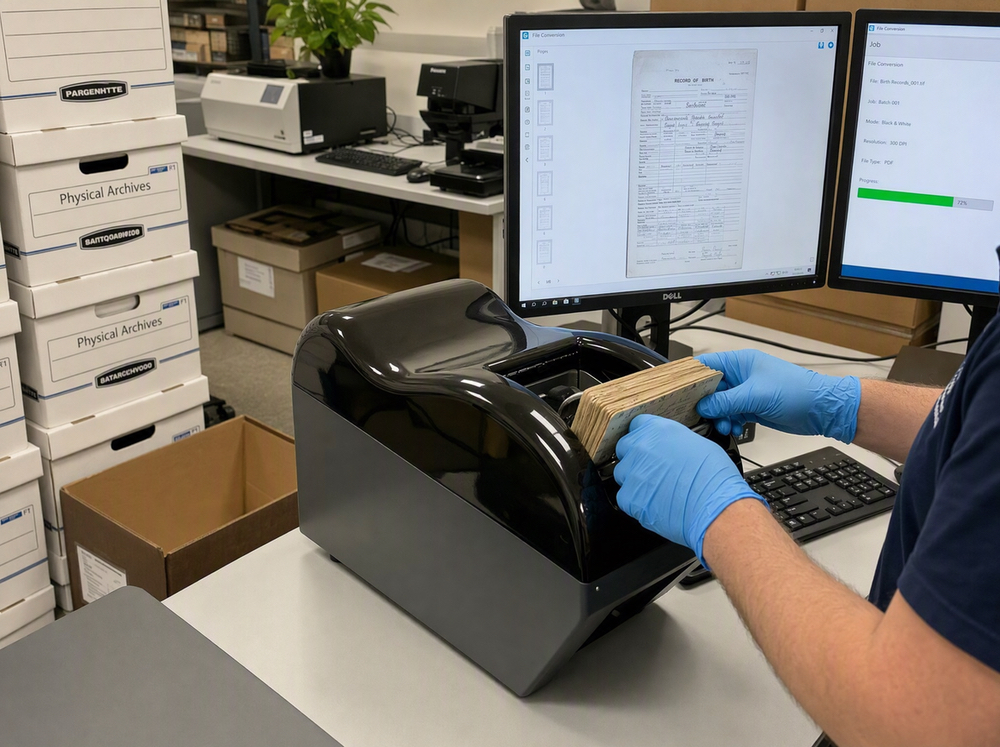
An aperture card holds a drawing nobody can view without equipment your building probably scrapped years ago. Aperture card scanning across the Carolinas captures the film window as a clean digital image and pulls the Hollerith punch data off the card so drawing numbers, revisions, and part numbers become index fields instead of holes. Files arrive in formats you already open. Call (704) 351-0949.
How Scanning & Indexing Works
Consult & Quote
Free Assessment
We review your volume, file types and indexing needs, then quote flat, all-in pricing with no contract.
Outcome:
Free, No-Obligation Quote
Collect & Prepare
Boxes or On-Site
We pick up your boxes under chain of custody, or scan on-site when material is too sensitive to move.
Outcome:
Chain of Custody Intact
Scan &
Index
OCR and Indexing
High-volume scanners with double-feed detection capture every page, and OCR makes the text fully searchable.
Outcome:
Every Page Searchable
Deliver & Dispose
Built To Your Workflow
Files arrive in the formats you use, index data in Excel, and originals shredded or stored on request.
Outcome:
A Paperless Archive
Aperture Card Scanning FAQs
What manufacturers and engineering firms ask before converting a card file: what an aperture card is, how the punch data is read, image quality, and card volume.
It is a punch card with a rectangular window holding a frame of 35mm microfilm, usually a single engineering drawing. Manufacturers, utilities, defense contractors, and municipalities filed millions of them from the 1950s onward because a cabinet of cards replaced a room of rolled prints.
The punched holes along the card carry index data such as drawing number, revision, sheet, and part number, which is what let a sorting machine find a specific card. Today the cards outlast the machines, and most organizations that still have them cannot view a drawing without shipping the card somewhere. That is the problem this service solves.
Yes. The punch data is the whole reason aperture cards are worth converting rather than simply reshooting. Capturing it turns decades of cataloging work into ready-made index fields, so your digital drawing set arrives already organized by drawing number, revision, and whatever else the cards encode.
Card formats were never fully standardized, so we read a sample against your legend before running the file and confirm the fields map the way you expect. Where cards were also typed or stamped along the top edge, that text can be captured too. Index data is delivered as an Excel or comma-delimited file for import into your PLM or document management system.
Better than most people expect. A well-shot card from a crisp original produces a readable full-size drawing, with dimensions and title block legible on screen and in print. The digital image inherits whatever the camera captured, so the quality ceiling was set decades ago when the card was made.
Cards shot from a faded blue-line print, or ones scratched from years of sorting, come through weaker, and capture settings can only recover so much. We evaluate a representative handful before quoting and tell you what to expect rather than discovering it at delivery. Output is typically TIFF or PDF, your choice, with no proprietary viewer required.
No. High volume is the normal shape of an aperture card project, and we have scanned over 100 million pages since 1998 across every format a Carolina business has walked in with. Large card files are processed in defined batches so you get usable drawings as the project moves rather than everything at the end.
There is no long-term contract, so a first batch can serve as a working pilot and you decide about the rest afterward. When the cards themselves are no longer needed, we destroy them securely under a Certificate of Destruction, which matters if the drawings are proprietary. Call (704) 351-0949 for a quote.
Watch Your Documents Destroyed, Then Take the Certificate
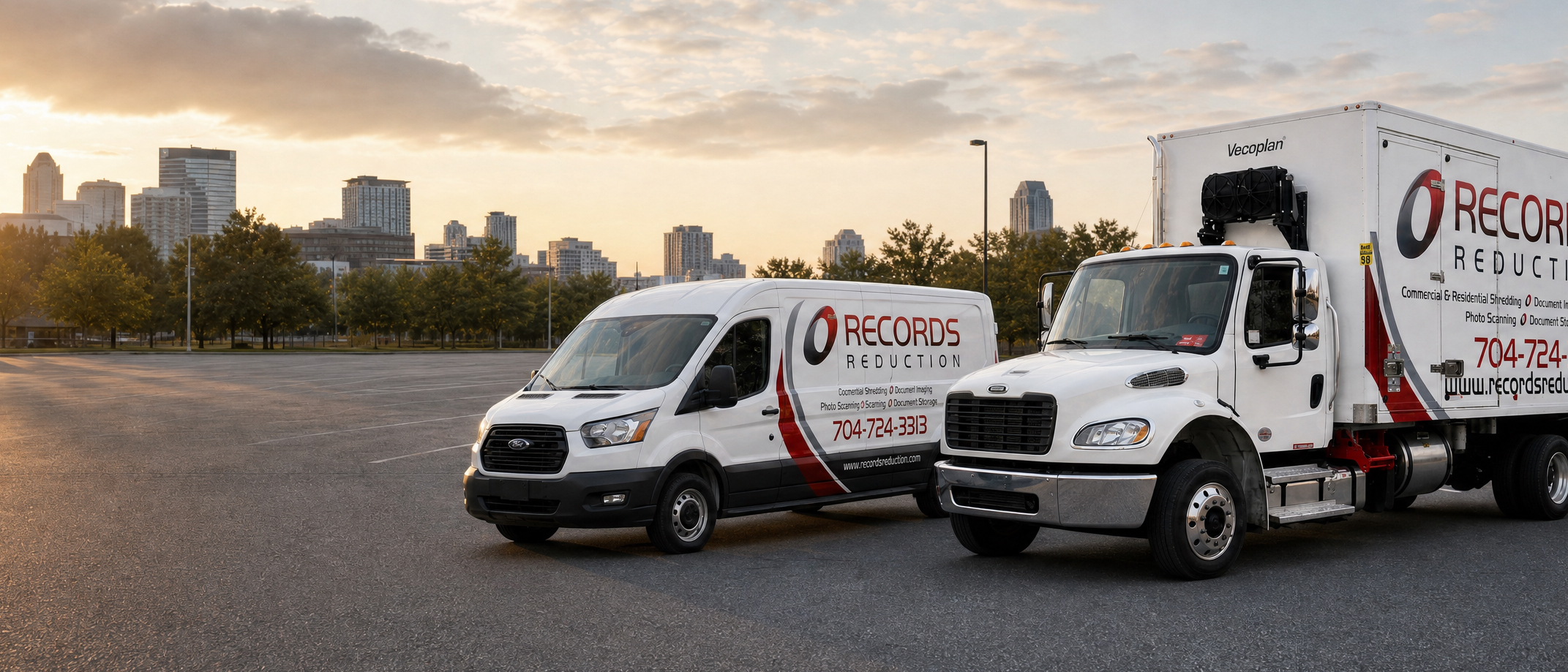
Our mobile trucks shred at your curb, and you are welcome to watch the whole load go through the viewing station. Every job at Records Reduction is handled under strict chain of custody by background-checked staff, and it ends with a Certificate of Destruction listing the date, the location, and what was destroyed. The shredded paper is then baled and recycled, all of it. Nothing gets stored, sorted, or hauled away intact.
Client Reviews
Businesses across the Carolinas trust Records Reduction for secure, on-time document shredding and scanning.
Get a Free Quote on Shredding or Scanning Today
Locally owned since 1998, with mobile trucks running Charlotte, Huntersville, and the Grand Strand every week.
Serving all of North & South Carolina
Our Locations
Three staffed offices across the Carolinas, plus two partner drop-off points for smaller jobs. Mobile shredding trucks reach every county we serve.
- (704) 351-0949
- info@recordsreduction.com
- Fax: (704) 631-4539
- NAID AAA Certified destruction
- Certificate of Destruction on every job
- Locally owned since 1998 — not a franchise
“They pulled the truck right up to our building and we watched every box go in. Scheduling was easy, the price was exactly what we were quoted, and the certificate was in my inbox the same afternoon. This is how it should work.”— Verified Google Review
All offices: Monday – Friday, 8:30 AM – 5:00 PM
Drop-Off Partners
Drop-off onlyIndependent partner businesses that accept smaller shredding drop-offs on our behalf — these are not staffed offices.
Bizxpress
3116 Weddington Rd #900, Matthews, NC 28105
Mon – Fri, 8:30 AM – 6:30 PM
Sat, 9:00 AM – 3:00 PM